


For the 250th anniversary of the United States, the Postal Service released one of the most unusual series in recent years: "American Icons", created with the participation of legendary fashion designer Ralph Lauren.
There are designers who create beautiful clothes, those who shape fashion, and those who become the creators of a national image. For millions of people around the world, America looks exactly as Ralph Lauren once saw and showed it. He became the man who, for nearly six decades, told the world his own American story.
When a fashion designer creates postage stamps
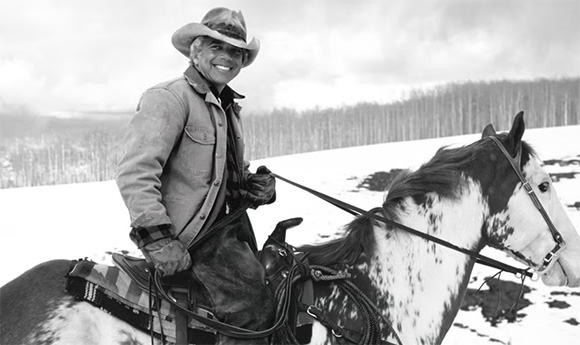
This is the first such project in the history of American philately. The USPS didn't simply invite a renowned artist to design the stamps. Ralph Lauren became the curator of the issue.
He was asked to select images that, in his opinion, best reflect the American character and values. The sources included photographs from the designer's own archive as well as the works of other artists who inspired him throughout his career.
As Ralph Lauren himself noted: "I love America. The images represented in this stamp collection symbolize the ideals, traditions, and spirit that unite us. They reflect the dreams, resilience, and enduring optimism that have inspired me throughout my life and career."
Today, the name Ralph Lauren - American fashion designer - is known worldwide, but his story began quite modestly. The future designer was born in New York City to Jewish immigrants from Eastern Europe. Ralph himself later recalled that from childhood he was fascinated by cinema, old America, English aristocratic culture, and the romance of the American West. In 1967, he founded his own company, Polo Ralph Lauren. Unlike most fashion designers, Lauren never simply sold clothes. He created a lifestyle. His advertising told stories: family ranches, New England yachts, college campuses, rodeos, horseback riding, and the vast Western plains. Gradually, this artistic world itself became part of American culture.
Simple Symbols of the Country
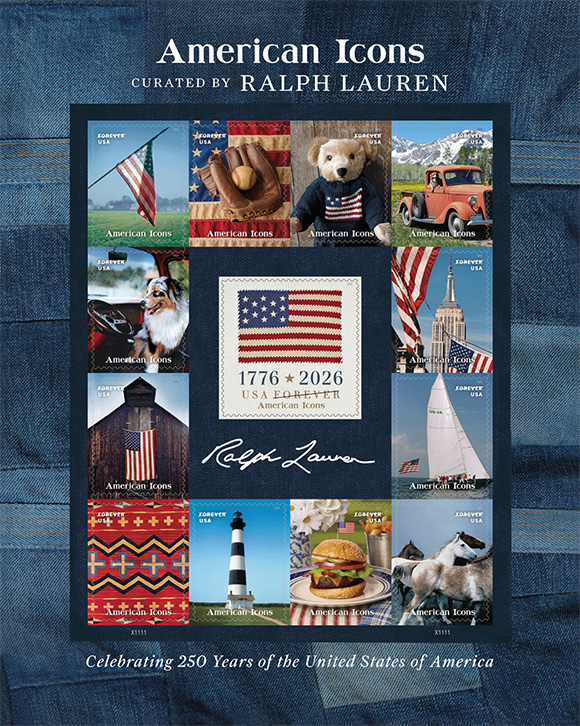
The mimiature sheet, issued by the U.S. Postal Service on June 9, 2026, consists of 13 self-adhesive postage stamps.
The center of the sheetlet features a postage stamp featuring a knitted American flag, inspired by the famous Ralph Lauren Flag Sweater, with the inscription 1776–2026. Around it are 12 other postage stamps arranged in a frame. The stamps depict the American flag, Jackie Robinson's baseball glove, an old pickup truck, a dog, the Empire State Building, a rural barn, a Diné (Navajo) blanket, a teddy bear, a lighthouse, a hamburger, a racing sailboat, and a herd of wild horses. Each motif symbolizes one of the country's values: freedom, equality, hard work, hope, creativity, the pursuit of success, and respect for tradition. The background of the entire sheetlet is blue denim - another symbol of America.
Each stamp represents one of the images associated with Ralph Lauren's work. Together, they form a unique visual narrative about how Ralph Lauren saw and presented America to the world.
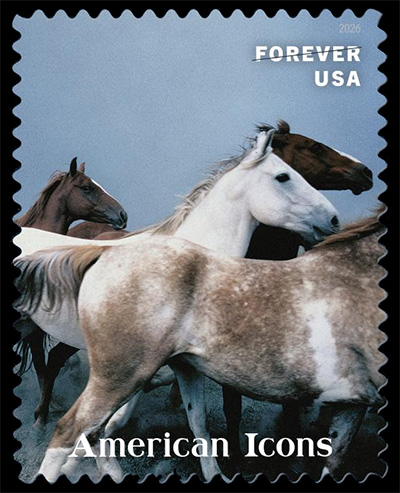
Wild horses are one of the symbols of America.
The stamp featuring wild horses holds a special place in the series.
For Ralph Lauren, the horse is not a decorative element or simply a brand logo. For decades, it has remained one of the central images of his work. Equestrianism, ranching, the American West, open spaces, and a sense of freedom are constantly present in the fashion house's advertising campaigns and collections. Therefore, the inclusion of wild horses in the American Icons series seems entirely natural.
Mustangs are one of the most recognizable figures in American history. Descendants of horses brought by European settlers, they became an integral part of the exploration of the Wild West. Over time, their image acquired symbolic significance. Mustangs are associated with freedom, strength, and independence. The official USPS description of the series confirms this idea with one short but very precise phrase: "Running wild, they embody the spirit of independence and the freedom we all strive for."
The Story of a Photograph
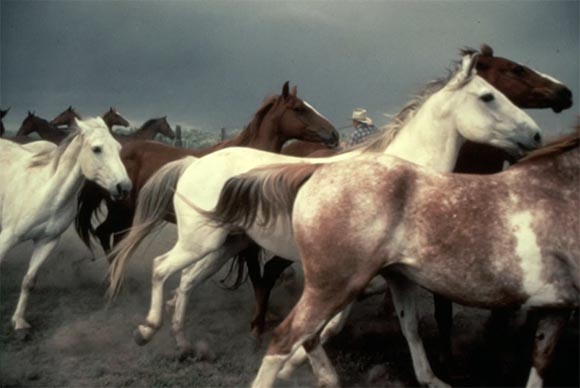
The stamp with the horses could have remained simply a throwaway image, creating the right atmosphere. But I really wanted it to have a story behind it. After conducting my research, I can confidently say that this is indeed the case. And the story began a full 43 years ago.
The photograph was taken by renowned American photographer Kurt Markus in 1983 near the small town of Tuscarora, Nevada. At the time, Markus traveled extensively throughout the American West, photographing cowboys, ranches, and free-roaming horses.
Kurt Markus had a fruitful collaboration with Ralph Lauren for many years, creating advertising campaigns and editorial shoots inspired by the American West. His calm, documentary style proved remarkably in tune with the brand's aesthetic, in which cowboy ranches, open prairies, and horses were not a decorative backdrop, but part of a larger narrative about America.
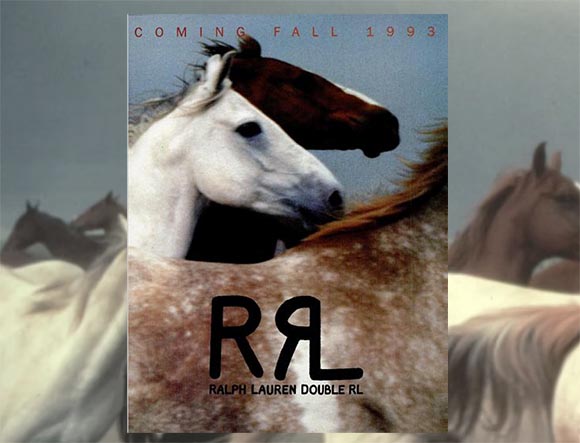
Ten years later, in 1993, Kurt Marcus's photograph of wild horses became one of the key visual images in the advertising campaign for Ralph Lauren's new collection, RRL (Double RL). The new clothing line was inspired by the American frontier and ranch culture. Ralph Lauren later purchased the original negative and copyright from the photographer, something that rarely happens with commercial photography.
Ralph Lauren himself later explained his choice: "Markus's photograph of wild horses in Tuscarora, Nevada has always inspired me. It represents a spirit of freedom that reminds me of living out West, which led me to choose it as the main image of the launch of our RRL brand in 1993. There is a faded beauty to the color of the horses and the sky that makes it feel like a picture from long ago."
Kurt Marcus - Photographer of the American West
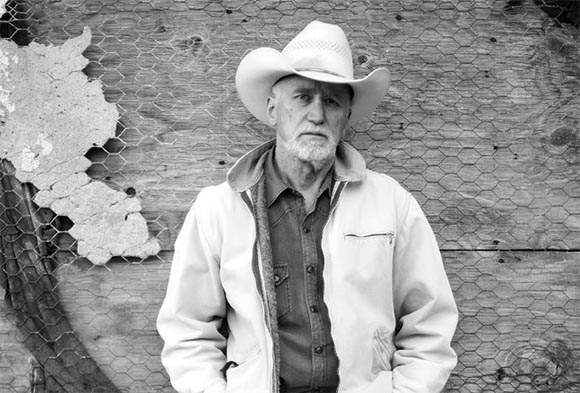
Kurt Marcus (1947-2022) is considered one of the most renowned photographers of the American West.
Marcus was born in Montana, amidst the vast prairies, where horses, ranches, and cowboys were not museum curiosities but a part of everyday life. This environment shaped his entire creative career. Having gained recognition as one of the leading masters of advertising and magazine photography, he never lost his interest in the people of the West – ranchers, cowhands, rodeo participants, and, of course, horses.
Unlike many photographers who created a spectacular, almost Hollywood-style image of cowboy America, Marcus strove for documentary authenticity. He shot primarily on medium-format black-and-white film, using natural light and avoiding elaborate staging. His photographs are distinguished by a remarkable calm: the viewer seems not to be a witness to a performance, but an accidental participant in real life. That's why his work has become a classic of documentary photography.
He gained real fame with his books After Barbed Wire, Cowboys, and Buckaroo, as well as his long-term collaborations with Life, Time, Newsweek, National Geographic, Sports Illustrated, and The New York Times Magazine. Dozens of celebrities, from actors and musicians to politicians, have graced Marcus's lens, but the photographer himself always admitted that he most enjoys returning to the ranch, where the protagonist remains the man and the horse.
The First Day of a New History
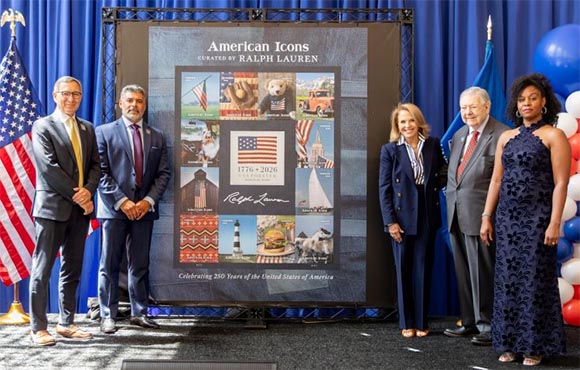
The presentation of the "American Icons" postage stamp series took place on June 9, 2026, in New York City at the historic James A. Farley Post Office Building. It's fitting that the ceremony took place in New York City, where Ralph Lauren's story began. Elliott Gruber, Director of the Smithsonian Institution's National Postal Museum, and representatives of the USPS and Polo Ralph Lauren attended the event. The post office also issued first-day covers and a special commemorative postmark.
On the day of the stamp release, Ralph Lauren also unveiled a small commemorative apparel collection dedicated to the issue. It included a reimagined Flag Sweater, the central stamp on the sheet, as well as a polo and baseball cap featuring motifs from the new series. This once again emphasized that the American Icons project was more than just a philatelic issue, but a rare example of the intersection of fashion, photography, and the postal service.
More than forty years have passed since Marcus pressed the shutter on his camera. During this time, the photograph has become one of Ralph Lauren's most recognizable advertising symbols, returning as a sportswear print in 2024, and receiving a new life in 2026 as a postage stamp.
Such is the remarkable fate of this photograph—its journey from a documentary snapshot to one of the symbols of modern America, captured in a postage stamp miniature.
You can find the technical details of the issue in the Catalogue.
Sources: stampsforever.com, ralphlauren.com, kurtmarkus.com
Afterword
While working on this article, I experienced an extraordinary creative surge. I really love it when there is an interesting story behind a brand. When you get hooked on one fact, you can pull a thread and unwind a whole ball in which different events and destinies of different people are intertwined. And in the end they all converge at one point - in a small postage stamp in which a big story is hidden.
Перейти в каталог
I apologize for any errors or inaccuracies